2026-11-28 · 8 min read · Simi Valley
Section 121 Home Sale Exclusion for Simi Valley Sellers Who Move
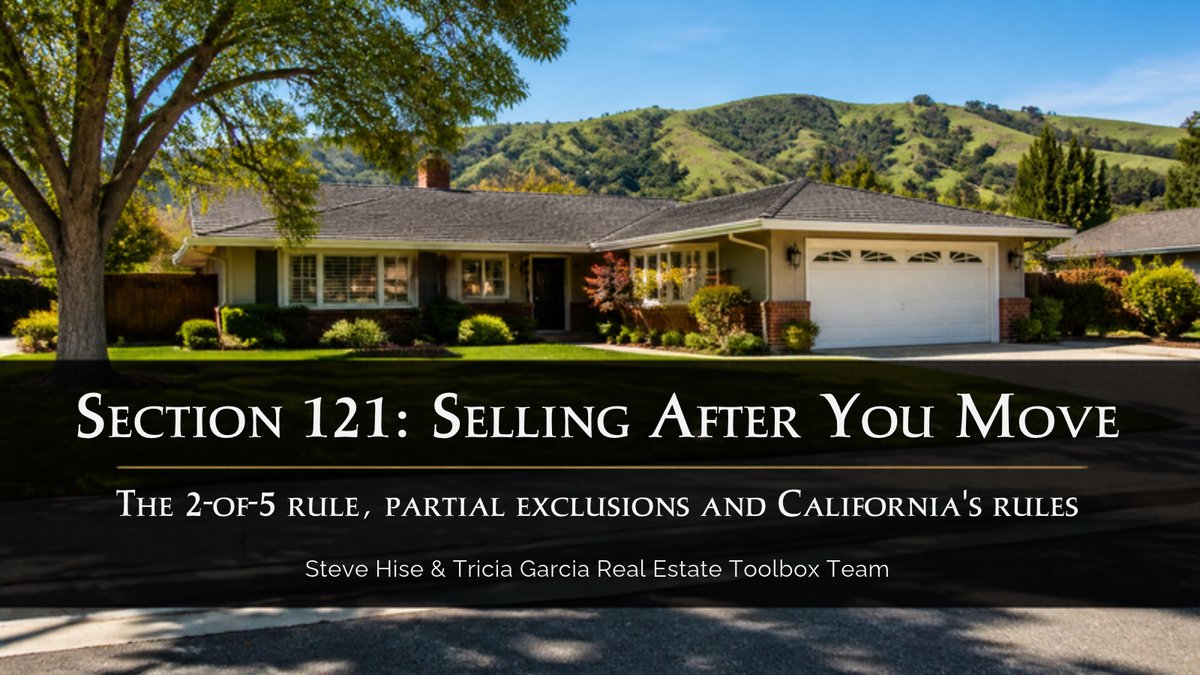
Does Section 121 Still Work If You Move Out of State?
If you sell your Simi Valley home and move out of state, does Section 121 still protect your gain? Yes, as long as you meet its tests. Section 121 of the Internal Revenue Code lets you exclude up to $250,000 of gain ($500,000 for most married couples filing jointly) if you owned the home and lived in it as your main home for at least 2 of the 5 years before the sale. If you fall short because of a job move, a health reason or an unforeseeable event, you may still qualify for a partial exclusion. California follows the same rules, and it still taxes any gain above the exclusion after you leave.
Updated November 2026. By Steve Hise & Tricia Garcia Real Estate Toolbox Team, Simi Valley real estate agents at eXp Realty (DRE #01702055 / #02032007).
Our capital gains guide covers how to figure your gain. This post is for sellers in Simi Valley, Moorpark, Thousand Oaks and the San Fernando Valley who are moving or already moved. The rules come from IRS Publication 523 (2025) and the Franchise Tax Board. Talk with a CPA before you list.
The 2-of-5 Rule, Step by Step
Publication 523 calls it the Eligibility Test. You get the full exclusion when you pass all three parts:
- Ownership: you owned the home for at least 24 months in the 5 years leading up to the date of sale. The IRS means the date of the closing, not the day you accept an offer.
- Residence: you lived in it as your main home for at least 24 months (730 days) in those same 5 years. The months can fall anywhere in the window and don't have to be one block of time. A vacation or other short absence still counts as time you lived there.
- Look-back: you didn't take the exclusion on another home sale in the 2 years before this one.
Married filing jointly: for the $500,000 limit, only one spouse has to meet the ownership test, but each spouse has to meet the residence test and the look-back test.
Already Moved Out? Count Back From Your Closing Date
Because the test looks back 5 years from the closing date, a move-out starts a clock. If you lived in the home for exactly 2 years right before you left, the math gives you about 3 years after move-out to close and still pass the residence test. If you lived there longer, count your own months back from your expected closing date, not from the day you list.
Renting it out after you leave: Publication 523 says the time after you last used the home as your main home, within the 5-year window, is not "nonqualified use." So renting the home for a while after you move doesn't shrink the exclusion by itself. Two catches:
- Depreciation: you can't exclude the part of the gain equal to depreciation you claimed (or could have claimed) for periods after May 6, 1997. That part is taxed.
- California withholding: the FTB's 2026 Form 593 instructions let you skip withholding when the property was last used as your principal residence. If its last use was as a rental, a second home or a vacation home, that exemption doesn't apply, so escrow may withhold even when your gain is still excluded on your return. See our Form 593 guide.
Rental use before you moved in is different: gain tied to that period after 2008 generally can't be excluded. If the house is sitting empty, read selling a vacant house after you've moved away.
The Partial Exclusion: Work, Health and Unforeseeable Events
If you don't pass the full test, Publication 523 says you may still get a partial exclusion when the main reason for the sale was a change in workplace location, a health issue, or an unforeseeable event. Each one can apply to you, your spouse, a co-owner, or anyone else who lived in the home as their residence, and the event has to happen while you owned and lived in it.
- Work-related move: you took or were transferred to a job at least 50 miles farther from the home than your old work location. The IRS example: an old job 15 miles from the home and a new job 65 miles away. If you had no previous work location, the new job has to be at least 50 miles from the home.
- Health-related move: you moved to get or give treatment for a disease, illness or injury, for yourself or a family member on the IRS list; you moved to provide medical or personal care for one of those relatives; or a doctor recommended a change of residence because of a health problem.
- Unforeseeable events: the home was destroyed or condemned, or had a casualty loss from a disaster; a death; a divorce or legal separation; becoming eligible for unemployment compensation; a change in employment status that leaves the household unable to pay basic living expenses; and a few other events the IRS lists.
If nothing on the list fits, the IRS can still weigh the facts and circumstances, such as whether you sold soon after the situation came up and whether you could have expected it when you bought.
How a Partial Exclusion Is Figured
Worksheet 1 in Publication 523 starts with the shortest of three periods:
- the time you lived in the home during the 5 years before the sale,
- the time you owned the home before the sale, and
- the time since you last sold a home and took the exclusion, if that applies.
Divide that period by 24 (in months) or 730 (in days), then multiply by $250,000. Married couples filing jointly follow an extra step on the worksheet.
Made-up example: a single seller bought a Simi Valley home, lived in it for 12 months, and was then transferred to a job in another state, more than 50 miles farther away. 12 divided by 24 is 0.5, and 0.5 times $250,000 is a $125,000 maximum exclusion. If the gain is $125,000 or less, none of it is taxed. This is only an illustration; your CPA runs the real numbers.
What California Does With Section 121
The Franchise Tax Board says it directly: "We conform to the IRS rules." The same 2-of-5 ownership and use tests apply on your California return, and the FTB applies the $500,000 limit to married couples and registered domestic partners who file jointly and meet the tests.
Moving away doesn't take the sale outside California's reach. The FTB lists "the sale or transfer of real California property" as California-source income, which nonresidents report on Form 540NR. Gain that the exclusion covers isn't taxed; gain above it is. For the full picture, read how California taxes your home sale after you move out of state and our Leaving California hub.
Free guide: Leaving California, the Seller’s Game Plan. The tax questions to answer first, a worksheet for your walk-away number, three ways to time your sale with your move, and a 90-day checklist.
Records to Pull Before You Call a CPA
- Your purchase closing statement and your expected closing date.
- Proof of your move-out date, such as a new lease or utility shut-off.
- For a job or health move: the transfer letter or a doctor's written recommendation.
- Rental dates and any depreciation claimed on past returns.
- The date of any other home sale where you took the exclusion in the last 2 years.
Then get a realistic sale price so your CPA can work with real numbers. Start with a home value request, or see how we handle selling a home in Simi Valley. If you're buying in another state, we plan both moves together so you're not stuck in between.
Frequently Asked Questions
Can I still use the Section 121 exclusion if I've already moved out of California?
Yes, if you owned the home and lived in it as your main home for at least 24 months of the 5 years before the closing. California follows the same rules.
How long after moving out can I sell and keep the full exclusion?
Count back 5 years from the closing date. If you lived there exactly 2 years right before moving, that leaves about 3 years. Check your own dates with a CPA.
What counts as a job move for the partial exclusion?
A new job or transfer at least 50 miles farther from the home than your old work location, or, with no previous work location, a new job at least 50 miles from the home.
Does renting my home after I move out reduce the exclusion?
Not by itself, within the 5-year window. But gain equal to depreciation after May 6, 1997 can't be excluded, and the Form 593 principal-residence withholding exemption doesn't apply if the home's last use was as a rental.
Does California tax my home sale after I become a nonresident?
Gain above the exclusion, yes. The sale of California real property is California-source income, reported on Form 540NR.
Talk With Steve and Tricia
Selling in Simi Valley while you plan a move out of state? We'll estimate your sale price and walk through timing so you and your CPA can plan around your dates. Schedule a call or call or text 805-424-6226. Our office is at 1720 E Los Angeles Ave, Suite F, Simi Valley, CA 93065.
Sources
- IRS Publication 523 (2025), Selling Your Home: irs.gov/publications/p523 (read November 28, 2026)
- California Franchise Tax Board, Income from the sale of your home (last updated 01/07/2026): ftb.ca.gov (read November 28, 2026)
- California Franchise Tax Board, Part-year resident and nonresident: ftb.ca.gov (read November 28, 2026)
- California Franchise Tax Board, 2026 Instructions for Form 593: ftb.ca.gov (read November 28, 2026)
Steve Hise and Tricia Garcia, Simi Valley real estate agents at eXp Realty
Steve Hise CA DRE #01702055 | Tricia Garcia CA DRE #02032007
This article is general information, not tax or legal advice. Tax rules change and every situation is different; talk with a CPA or tax attorney before you sell.